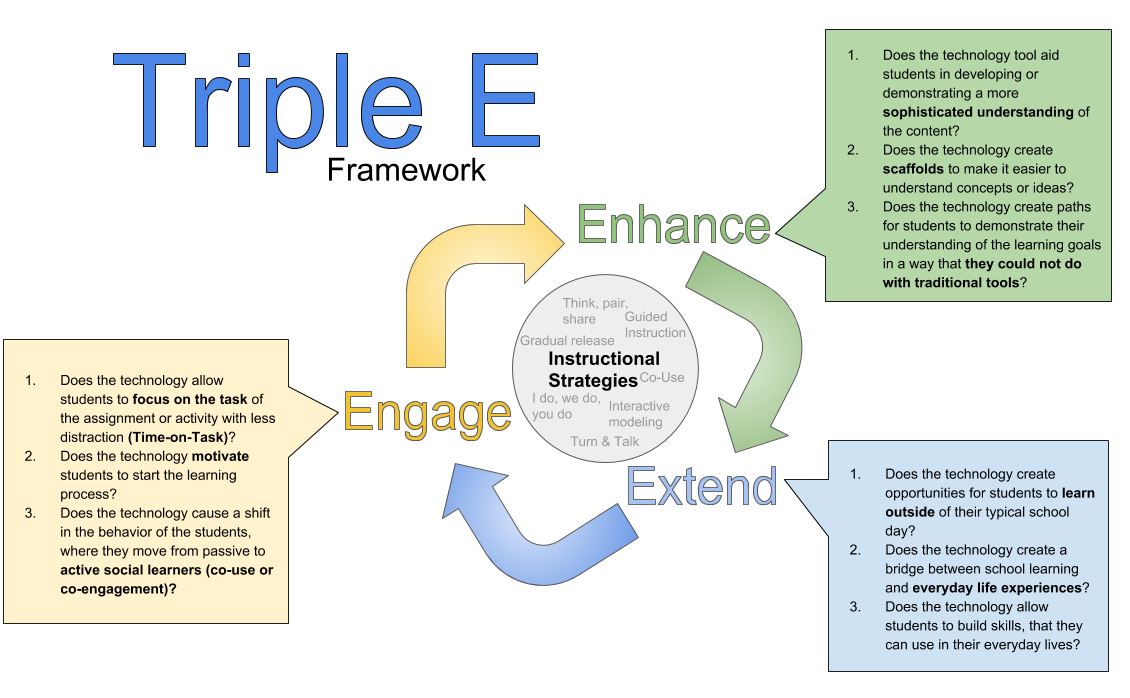
When looking at multiple different frameworks for technology in education, the Triple E Framework really stands out. The reason for this is because it allows for a quick and easy check if something is worth adopting. The main purpose of Triple E, as shown by the graphic above, is to see if it either engages, enhances, or extends the students learning. These three "E's" can make teachers or decision makers think hard on if new or existing technologies have positive improvements to students educational or personal life. I really appreciate the fact that this framework acknowledges that learning goes past the classroom.
I think this framework would be great for my district, or any district. Whether your district has a surplus or deficit of money, this would really help narrow the scope of technologies needed. When districts have too many, it makes it hard to become an expert on any of them. I am still very new to my district (still in PD week), but to be skilled or accomplished on the rubric one must use technology well. To use technology well, teachers with a finite amount of time must pick and choose the technologies to use with a framework like Triple E.
Being a student myself during the time of the computer lab and the induction of 1-to-1 laptops, it was new and exciting with each new thing that we were able to do with technology in education. However, I do believe that educational technology has become a lucrative enough business to have brought maybe a surplus of options. It is common to hear about or see students who hate their districts useful math technology software due to teachers letting it become the teacher. The Triple E framework focuses on "Education first, technology second" (Kolb 2015). This phrase clearly connects to the ISTE framework for educators, especially 2.3 which clearly emphasizes "2.3.a Creating positive experiences and 2.3.b Evaluate resources for credibility"(ISTE 2000).
When looking at specific initiatives in my school, I think it works perfectly for myself as a teacher who will be teaching math in a resource room setting. There is a strong push in our district to use many different technological resources. One is an entire curriculum while others focus mainly on assessment. The problem with this is more technology does not always mean more time. Within a public school setting, it can even slow things down. Putting that aside, it is my personal belief that there is still a place in the math classroom for both the student and teacher up on the board working on the problems together. When I recently received this vast access to a plethora of resources I quickly became overwhelmed. I think unknowingly today I used the Triple E framework before I had ever heard of it. One of the resources is one that students had been "plopped down" in front of, and now they hate or have gamed it to get nothing from it. I look at the engage within Triple E and know that is not something that would be beneficial to me or my students time.
References
International Society for Technology in Education. (2000). ISTE national educational technology standards (NETS). Eugene, OR :International Society for Technology in Education,
Kolb, L. (2015a, January 5). About Triple E Framework. Triple E Framework. https://www.tripleeframework.com/about.html

I really like how you connected the Triple E Framework to your own experiences both as a student and as a new teacher in your district. You make a great point that more technology doesn’t always equal better learning... sometimes it can even slow things down or overwhelm both teachers and students. I also liked how you talked about “education first, technology second.” That helps keep the focus on what matters most. I think your example of students disengaging from a program they’ve been “plopped down” in front of is so true, we see that a lot in math classrooms. The way you’ve already been applying Triple E without even realizing it shows how practical the framework can be!
ReplyDeleteI personally have great appreciation for Kolb's triple E Framework. Very relevant to preparing and designing a lesson plan.
ReplyDeleteMr. Fry,
ReplyDeleteThanks for sharing your post. I remember learning math from the chalk board and numerous assignments written from a textbook into a notebook. I recently have the experience of watching my daughter take an online math class she got behind with. It allowed her to take the time she needed to complete the class and to watch the graphics change accordingly to the numbers input into an equation. It is amazing to me someone having the creativity to create such an interactive format to learn math.
I agree with you that there is money put into this type of learning. My daughter's school had provided a borrowed laptop for the school year. As parents we only pay a small fee for the insurance. I don't really know who bought the laptops.
Thanks,
Monica