When looking at technology in education I think a lot or people struggle with the same thing. The unfortunate part about that is that it negates educational technologies most important part usually. The most common problem I see is not using technology on a consistent and timely schedule. It can often just be sprinkled in when things end fast, or even when the teacher is just having an "off day". Consistency is foundational to the efficacy of many educational technology programs. When looking at creating a "SMART" goal you want to make sure you break down the acronym. Specific meaning you know exactly what success looks like. Measurable meaning you can get quantifiable data telling you if you are doing it. Achievable meaning it seems reasonable to both the instructional coach and the teacher. Relevant meaning that it would be beneficial to the students. Time-bound meaning that there is a specific end point for the goal. The goal I would make for this teacher at the beginning of the year is that by the end of the first semester they will have their students use the provided educational technology program 3 times a week in 90% of weeks at the end of the semester. The first action step for this would be to at the beginning of the year choose a time of the day you want to implement this. If you are in the secondary level, it might be at the beginning of the period. If you are at elementary, this could be right after recess. In my experience, transitioning into it within the time period of the class can be extremely difficult. The second action step would be to create the routine for them using it. Setting a precedent at the beginning of the year that this is how we get on the computer and access this program in a timely manner will increase the time used well significantly. The last action step would be to choose the consistent days you want to do this. The initial thought would be to do a MWF set-up. However, looking at our goal of getting in three days, I would go TWTh due to the large amount of four day weeks in the fall.
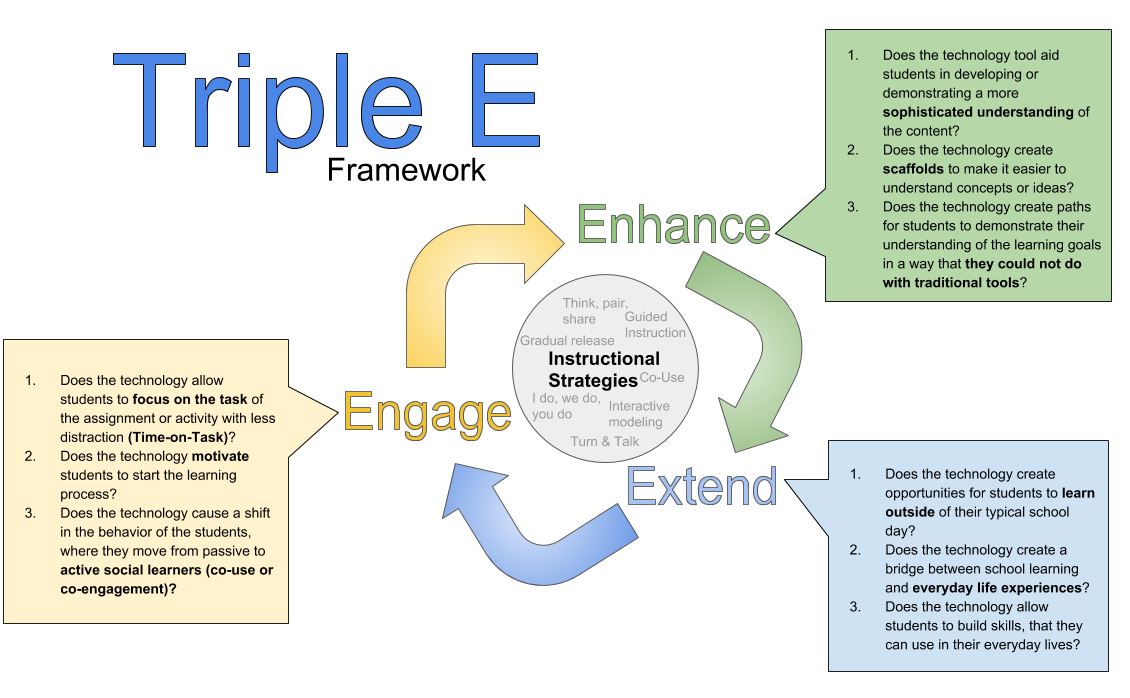
When looking at Triple E framework, the biggest focus on the teachers goal here would be around enhancing and engaging. When looking at how it enhances it, I would look at the framework’s question of “Does the technology create scaffolds to make it easier to understand concepts?”. The best part about a lot of these programs is that they scaffold up and down for students who are maybe behind or even ahead of what would be considered the “average” student. When looking at the engaging aspect, I look at the question of whether it increases time on task. Not only will the program increase time on task, but time on the correct task. The action steps laid out will also increase the amount of time on task with the built in routines and norms that cut down on wasted time.
The student ISTE standard that this goal addresses most is1.1.d if its younger students. Students becoming academically proficient with how to quickly and effectively login and navigate a computer in an academic setting. For older students I look at 1.1.c. Often times, students are able to see their own areas of weakness, strength, and growth. For the ISTE standards for educators that are addressed within the goal most closely are 2.3.a, which is creating positive experience. This program will get many students in front of content that is directly on their level. The “average” student rarely exists. With that being said, most curriculum will be a little behead or behind most every student. Time in front of material that is engaging, but not too much to understand, will create those positive experiences with learning.
` I felt like I most closely aligned my thinking with with the coach ISTE learning standard is 4.3.d. This was a great exercise in personalizing support for educators. Creating the smart goal was one thing, I feel like I personally do that for myself quite a bit. To me, making it personalized aspect was that it involved creating those action steps. It was a good reminder at how important that is to giving yourself small bites and steps to make your goal more achievable. I also tried to focus on not only steps toward it, but steps to prevent the teacher from failing. Foreseeing what could go wrong is definitely a skill I have learned the longer I have taught.